

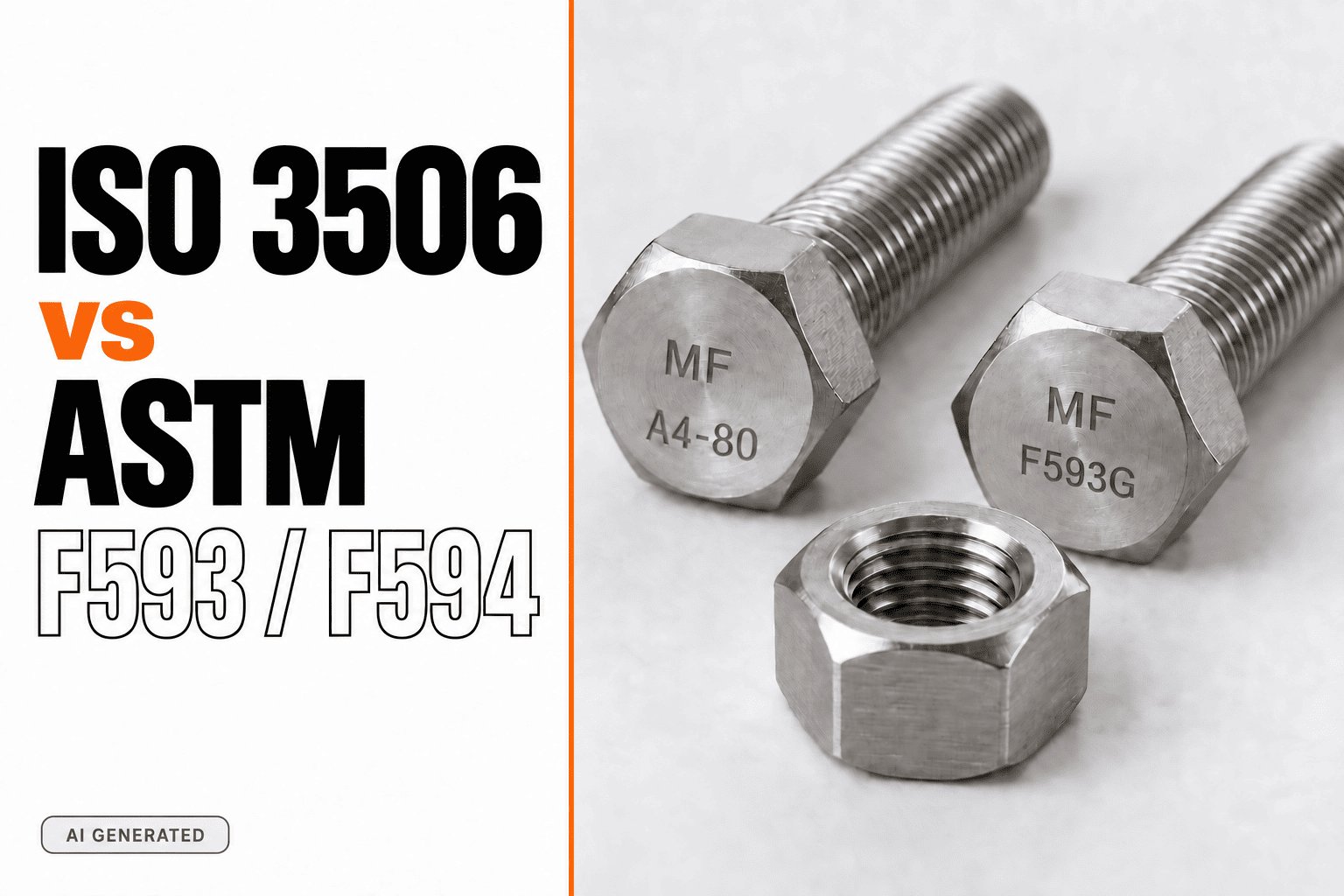
The European drawing says A4-80. The American one says ASTM F593. The buyer asks if they are the same screw, and the quick answer—“yes, more or less”—is the one that leads to disputes during acceptance.
The two standards describe the same item—a stainless steel screw—but they do so using two different approaches. There is no equivalence table that would allow one to be substituted for the other without verification. There is a general correspondence, useful for orientation, and a series of differences that matter when someone inspects the shipment.
Let’s see how both are interpreted, where the correspondence holds up and where it breaks down.
Two Different Approaches
It is the difference from which everything else stems.
- ISO 3506 specifies the material and performance requirements. The designation indicates which family the steel belongs to and what minimum tensile strength it guarantees.
A4-80means a Group 4 austenitic steel with a minimum tensile strength of 800 MPa. - ASTM F593 specifies the material and the condition of supply. The designation indicates which alloy group it belongs to and in what condition it was supplied—annealed, cold-worked, or high-strength cold-worked. The mechanical properties are determined by that condition; they are not the name of the grade.
To put it another way: in the ISO standard, the number represents the performance; in the ASTM standard, the performance is a value to be found in a table. That is why there is no direct translation between the two standards.
How to Read ISO 3506
The designation consists of a letter identifying the metallurgical family, a digit identifying the composition group, and a number indicating the strength class.
| Letter | Family | Typical Examples |
|---|---|---|
| A | Austenitics | A2 (Type 304), A4 (Type 316, with molybdenum) |
| C | Martensitic | C1, C3, C4 |
| F | Ferritic | F1 |
| D | Duplex | Introduced in the most recent update |
The strength class for austenitic steels follows a simple rule: multiply the number by 10 to get the minimum tensile strength in MPa. Class 50 for annealed steel, 70 for work-hardened steel, and 80 for high-strength work-hardened steel. Therefore, A4-80 guarantees a minimum of 800 MPa, while A2-70 guarantees 700 MPa.
The standard is divided into several sections: screws and studs, nuts, set screws, self-tapping screws, and, in the most recent editions, heat-resistant alloy fasteners. If you need more details on the first two sections, we’ve covered them in an article dedicated to male and female fastening systems.
How to Interpret ASTM F593 and F594
ASTM F593 covers stainless steel screws, bolts, and studs; ASTM F594 is the corresponding standard for nuts. They must always be specified together when the order includes both: specifying only F593 on an order that includes nuts leaves the nut unspecified.
The classification is organized by alloy groups. The three most common in industrial applications are the austenitic alloys:
| Group | Alloys | European Correspondence |
|---|---|---|
| Group 1 | Type 304 and similar grades | Area A2 |
| Group 2 | Type 316, with molybdenum | Area A4 |
| Group 3 | Types 321 and 347, stabilized | Area A3 / A5 |
Each group is accompanied by a condition: annealed, cold-work hardened, or high-strength cold-work hardened. The marking on the head combines these two pieces of information into a single code, and this is what confuses those coming from the ISO world: that letter does not indicate a strength class. To determine the guaranteed values, you must cross-reference the group, condition, and diameter in the standard’s tables.
The indicative correspondence
With all due caution, to help you navigate the bidding process:
| If the drawing says | Look toward |
|---|---|
| A2-70 / A2-80 | F593 Group 1, work-hardened condition |
| A4-70 / A4-80 | F593 Group 2, work-hardened condition |
| A2-50 / A4-50 | Group 1 or 2, ricotta-like consistency |
| A2 / A4 Nuts | F594, corresponding group |
Where the connection breaks down
The diameter
This is the most insidious difference, because it does not appear in the standard’s title. In both standards, the properties of work-hardened steel decrease as the diameter increases: beyond certain sizes, it is no longer possible to guarantee the values of the highest classes, and the strength either decreases or must be agreed upon by the parties.
The problem is that the size thresholds of the two standards do not match. A correspondence that holds true for small diameters may not hold true for an M30, and this verification must be based on the actual dimensions of the job, not on the designation.
Testing, Marking, and Documentation
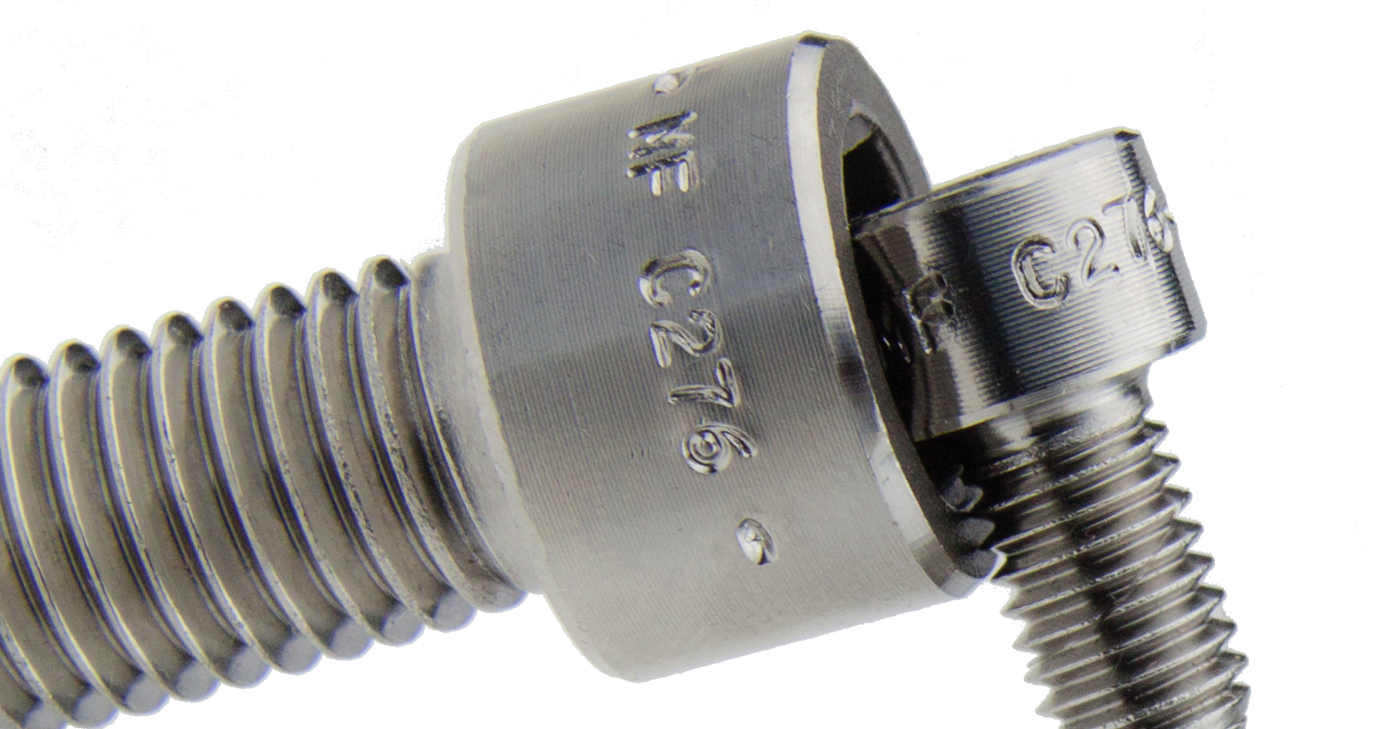
Test requirements, sampling criteria, and marking rules are changing. A screw may meet the mechanical specifications of another standard and still be noncompliant because the marking on the head is not as required, or because the documentation does not include the required test results. During acceptance, the marking is checked before the certificate.
Metric or Imperial
F593 and F594 are based on the imperial system. If the American drawing is in millimeters, the correct reference may be another ASTM standard in metric units: it’s worth asking, because citing the wrong standard is a formal error that will prevent acceptance even if the delivery is flawless.
What about ASTM A193 B8 / B8M?
This is where the most common confusion arises, because the categories of materials are similar. These are rules from different areas, and it is not a matter of preference: the type of application determines which one applies.
| Rule | Scope |
|---|---|
| ASTM F593 / F594 | Stainless Steel Fasteners for General Use |
| ASTM A193 / A194 | Fasteners for high-pressure and high-temperature applications |
| ISO 3506 | Stainless steel fasteners for general use, European market |
The fact that bothA193 B8M and A4-80 are based on work-hardened 316 does not make them interchangeable: they comply with different test specifications and are designed for different applications. For a pressure flange, the standard is A193, not F593, and vice versa for general structural steelwork.
Furthermore, within the A193 itself, the distinction between Class 1 and Class 2 introduces an additional level that is worth understanding, and it is a topic in its own right.
What to Do in Practice
- Ask for the full designation, not just the standard’s abbreviation: you need the group, condition, and class.
- Check the edition of the referenced standard: ISO 3506 has been substantially revised, and the groups and classes are not identical across editions.
- Check the diameter against the property degradation thresholds based on the actual dimensions of the job.
- List F593 and F594 together if the supply includes screws and nuts.
- Agree on the marking before production: it’s the first thing checked during inspection.
- Consider dual certification when the material allows it: it’s the most reliable way to serve customers on both sides of the Atlantic without duplicating inventory.
- Do not declare equivalencies based on a conversion table. If the contract specifies a standard, the supply must comply with that standard.
In summary
ISO 3506 and ASTM F593/F594 describe the same product using two different formats: the first includes the performance specification in the class name, while the second specifies the delivery condition and lists the properties in a table, which also takes diameter into account.
The correspondence between A2 and Group 1, and between A4 and Group 2, is a good starting point for mutual understanding during the bidding process. It is not a basis for a declaration of conformity, and the difference between the two is measured in the number of disputes avoided.
If you’re working on U.S. government contracts, another requirement worth clarifying up front concerns the origin of the material: we discussed this in the article on DFARS and specialty metals. For a general overview of steel grades, the guide to materials science remains a useful resource.
If you have a drawing with American designations and need to determine what to manufacture, our engineering department can help you translate the requirements into a supply specification: please contact us, specifying the applicable standard, the diameter, and the quantities.