

What Are the ISO 3506-1 and ISO 3506-2 Standards?
The ISO 3506 standards constitute the regulatory framework governing fasteners made of stainless steel. This family of standards is divided into specific parts:
- ISO 3506-1: specifies the requirements for male fastening systems (bolts, screws, studs)
- ISO 3506-2: specifies the characteristics for female fastening systems (nuts)
- ISO 3506-3: Self-tapping screws
- ISO 3506-4: covers self-tapping screws
- ISO 3506-6: covers the general properties of stainless steel
The most recent major revision, published in 2020, introduced substantial changes compared to the previous version, expanding the available strength classes and updating the test methods.
Stainless Steel Grades and Strength Classes in ISO 3506-1
The ISO 3506-1 standard for male fastening systems specifies various grades of stainless steel, each with specific mechanical properties. MF Inox materials strictly comply with these classifications to ensure certified performance.
Types of Steel According to ISO 3506-1
The stainless steels used for fasteners fall into four main categories:
- Austenitic steels: characterized by excellent corrosion resistance and good ductility (e.g., A2, A4, A5)
- Martensitic steels: They offer high mechanical strength but lower corrosion resistance (e.g., C1, C3, C4)
- Ferritic steels: They combine corrosion resistance and magnetic properties (e.g., F1)
- Duplex steels (austenitic-ferritic): combine high mechanical strength with excellent corrosion resistance (e.g., D2, D4)
Strength Classes and Designations
Strength classes indicate the minimum mechanical properties of fasteners. The designation consists of:
- A letter identifying the steel grade (A, C, F, D)
- A number that indicates the specific grade of steel
- A final number representing the tensile strength class (50, 70, 80, 100, 110)
For example, A2-70 stands for: austenitic steel (A), grade 2, strength class 70 (minimum tensile strength of 700 N/mm²).
| Designation | Steel Grade | Min. Tensile Strength (MPa) | Min. Yield Strength (MPa) | Min. Elongation (%) |
|---|---|---|---|---|
| A2-50 | Austenitic | 500 | 210 | 0.6d |
| A2-70 | Austenitic | 700 | 450 | 0.4d |
| A4-80 | Austenitic | 800 | 600 | 0.3d |
| A4-100 | Austenitic | 1000 | 800 | 0.2d |
| C4-70 | Martensitic | 700 | 450 | 0.2d |
| F1-45 | Ferritic | 450 | 250 | 0.2d |
Mechanical and Physical Properties Specified in ISO 3506-1
The ISO 3506-1 standards for male fastening systems precisely define the mechanical properties that bolts, screws, and studs must possess. These requirements are verified through standardized tests conducted at room temperature.
Basic Strength Requirements
Fasteners must simultaneously meet all of the following applicable requirements:
- Tensile strength: the ability to withstand axial loads without breaking
- Yield load: the limit beyond which permanent deformation occurs
- Elongation after fracture: a measure of a material’s ductility
- Hardness: resistance to penetration and surface deformation
- Resilience: the ability to absorb energy before breaking
The Influence of Geometry on Performance
It is essential to understand that even fasteners made from materials that comply with the standard may not meet all strength requirements due to specific geometric characteristics:
- Head geometry: countersunk, cap, or low-profile heads have a smaller cross-sectional area than the stress area in the thread
- Shaft geometry: shafts with a cross-section smaller than that of the thread can be potential failure points
- Thread length: The effective engagement length significantly affects the load-carrying capacity
For non-standard fasteners, it is always advisable to consult an expert or the manufacturer to verify their suitability for the application.
Tensile Tests for Fasteners According to ISO 3506-1
Tensile tests are the primary method for verifying that male fasteners comply with the requirements of ISO 3506-1:2020. These tests must be performed according to standardized procedures to ensure comparable and reliable results.
Tensile Testing Methodology
The standard tensile test involves:
- Mounting the fastener in special test fixtures
- Application of an Increasing Axial Load at a Controlled Rate
- Recording of the maximum load withstood before failure
- Measurement of Residual Elongation After Fracture
- Testing the Fracture Mode (Ductile or Brittle)
When the Tensile Test Is Not Applicable
In some cases, the standard tensile test cannot be performed due to dimensional limitations. Specifically, when:
- The length of the element is l < 2.5d (where d is the nominal diameter)
- The effective thread length is b < 2d
In these situations, the standard provides for an alternative method: the breaking torque test.
Torsional Strength Test: An Alternative to Tensile Testing
When required, the breaking torque test replaces the tensile test for bolts, screws, and studs with full load-bearing capacity. However, there are important limitations:
| Category | Available Torque Values | Notes |
|---|---|---|
| Austenitic grades 50, 70, 80 | Available | For coarse-pitch threads only |
| Class 100 austenitic grades | Not available | To be agreed upon with the manufacturer |
| Fine-pitch thread | Not available | To be agreed upon with the manufacturer |
| Martensitic, ferritic, and duplex steels | Not available | To be agreed upon with the manufacturer |
In cases where the minimum torque values are not specified by the standard, they must be agreed upon between the buyer and the manufacturer at the time of ordering, based on the specific application and the material properties.
ISO 3506-2 Standard for Female Fastening Systems
While ISO 3506-1 covers male fasteners, ISO 3506-2 focuses specifically on female fastening systems, primarily stainless steel nuts.
Specific Requirements for Dice
ISO 3506-2 defines different requirements for nuts compared to male elements, taking into account:
- Test load: the axial stress that the nut must withstand without permanent deformation
- Axial load resistance: the ability to maintain structural integrity under load
- Hardness: appropriate for the corresponding strength classes
- Screw compatibility: proper mating with male elements of the same class
Strength Classes for Dice
Nuts are classified based on their ability to withstand the test load without breaking or deforming. The designations follow a logic similar to that of ISO 3506-1:
| Nut Designation | Compatible with Screw | Test Load (MPa) | Typical Applications |
|---|---|---|---|
| A2-50 | A2-50 | 380 | General, non-structural applications |
| A2-70 | A2-70 | 580 | Standard Structural Applications |
| A4-80 | A4-80 | 640 | Corrosive environments with high loads |
| A4-100 | A4-100 | 830 | High-strength critical applications |
Testing Procedures for Nuts
The testing of nuts in accordance with ISO 3506-2 includes:
- Load test: application of the specified test load without failure
- Hardness Test: Surface Hardness Measurement
- Mating Test: Verification of Proper Interaction with the Screws
- Dimensional inspection: compliance with geometric tolerances
Applicability of Test Methods: ISO 3506-1 Reference Table
The ISO 3506-1 standard provides an applicability table that specifies which test methods are appropriate for verifying that fasteners of different types and sizes meet the regulatory requirements.
Criteria for Selecting a Test Method
The selection of the appropriate test method depends on several factors:
- Nominal diameter: d ≤ M39 or larger
- Nominal length: relationship between length and diameter
- Thread type: coarse or fine pitch
- Shaft configuration: fully threaded or partially threaded
- Head type: hexagonal, cylindrical, countersunk, etc.
| Element Type | Dimension | Length | Applicable Test Method |
|---|---|---|---|
| Hex Head Screws | M5 – M39 | l ≥ 2.5d | Tensile test |
| Hex Head Screws | M5 – M39 | < r 2.5d | Breakage torque test |
| Prisoner | M5 – M39 | b ≥ 2d | Tensile Test |
| Prisoner | M5 – M39 | b < 2d | Tensile Strength Test |
| Screws with Special Heads | Miscellaneous | Miscellaneous | To be evaluated on a case-by-case basis |
Differences Between ISO 3506:2009 and ISO 3506:2020
The 2020 revision introduced significant changes compared to the previous 2009 edition, improving regulatory clarity and expanding the available options.
Key Changes in the 2020 Revision
- New Strength Classes: Introduction of Class 110 for Ultra-High-Strength Steels
- Expansion of steel grades: inclusion of new duplex and super-duplex steel grades
- Clarification of Test Methods: More Detailed Specifications for Test Procedures
- Traceability Requirements: Greater Emphasis on Documentation and Identification
- Update to Hardness Values: New Ranges for Certain Strength Classes
- Environmental Requirements: Considerations on Corrosion Resistance in Specific Environments
Practical Implications of the Update
The adoption of the new version entails:
- Need to Update Technical Specifications in Bidding Documents
- Verification of Supplier Compliance with the New Edition
- Possible changes to quality control processes
- Opportunities to use materials with superior performance
Selecting the Right Fasteners: Practical Considerations
Selecting fasteners that comply with ISO 3506-1 and ISO 3506-2 requires a careful evaluation of multiple application factors.
Key Selection Criteria
- Operating Environment
- Exposure to harsh chemicals
- Presence of marine or industrial environments
- Operating temperatures (low or high)
- Humidity and Condensation
- Mechanical stresses
- Static or dynamic loads
- Vibrations and Load Cycles
- The Need for Controlled Preload
- Material Compatibility
- Mating of a screw and nut of the same class
- Electrochemical compatibility with assembled components
- Avoid unfavorable electrochemical couples
- Specific Regulatory Requirements
- Regulated sectors (food, pharmaceutical, marine)
- Certifications required by the client
- Applicable local or international regulations
Common Mistakes to Avoid
When specifying and using stainless steel fasteners, it is important to avoid:
- Excessive oversizing: choosing strength classes higher than necessary increases costs without providing any benefits
- Incompatible pairings: Using nuts and screws of mismatched grades compromises performance
- Ignoring the corrosive environment: Not all stainless steels offer the same corrosion resistance
- Failure to account for geometry: countersunk heads or shortened shanks require specific evaluations
- Lack of adequate lubrication: galling is a common problem in stainless steel
Marking and Identification in Accordance with ISO 3506
Proper marking of fasteners is essential to ensure traceability and verification of compliance with ISO 3506-1 and ISO 3506-2.
Marking Requirements for Male Components
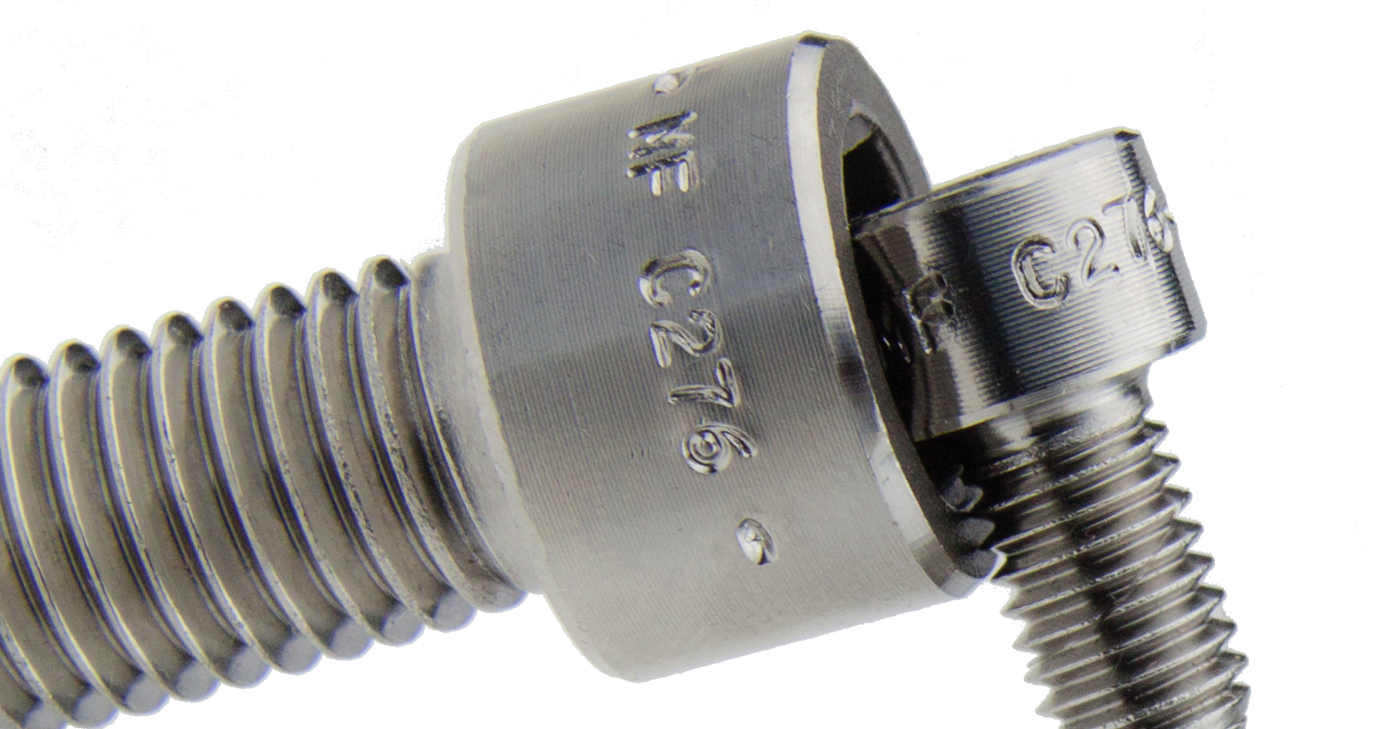
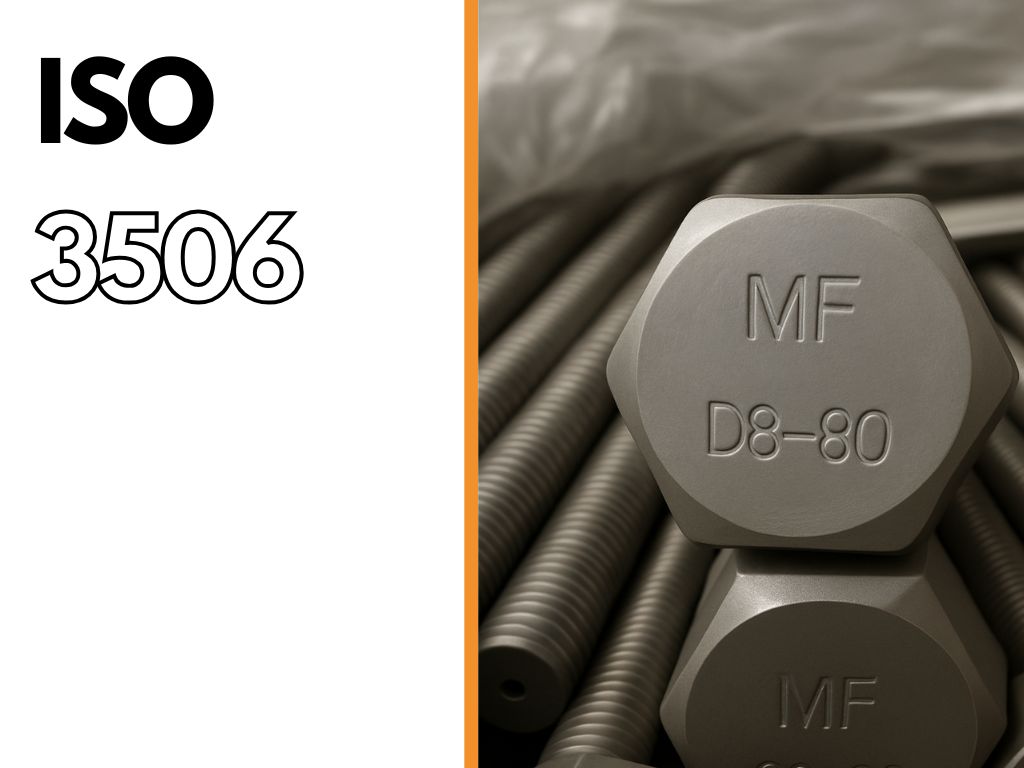
The ISO 3506-1 standard requires that male fasteners of the appropriate size be marked with:
- Manufacturer’s symbol: identifies the manufacturer responsible
- Strength class designation: indicates the mechanical properties (e.g., 70, 80)
- Steel grade identification: may be included in the marking (e.g., A4)
Marking is mandatory for components with a diameter exceeding certain size thresholds, while for smaller components, it may be replaced by accompanying documentation.
Identification of Nuts According to ISO 3506-2
Nuts that comply with ISO 3506-2 can be identified by:
- Marking on the top surface: manufacturer’s symbol and class
- Coding via Punches: Standardized Identification Systems
- Accompanying documentation: certificates of conformity and test reports
Quality Control and Certification of Fasteners
Compliance with ISO 3506-1 for male fastening systems and ISO 3506-2 for female fastening systems must be verified through rigorous quality controls during production and delivery.
Production Checks
Qualified manufacturers implement:
- Raw Material Inspection: Verification of the Chemical Composition of Steel
- Dimensional inspection: verification of geometric tolerances
- Random mechanical testing: tensile strength, hardness, breaking torque
- Surface inspection: visual inspection and defects
- Complete traceability: from raw materials to the finished product
Documentation and Certifications
The supply of critical fasteners should be accompanied by:
- Certificate of Conformity 2.1: Manufacturer’s Declaration
- Certificate 3.1 in accordance with EN 10204: with specific test results
- Test Reports: Detailed Results of Mechanical Tests
- EC Declaration of Conformity: When Applicable
Sector-Specific Applications of ISO 3506 Standards
The ISO 3506-1 and ISO 3506-2 standards are applied in numerous industrial sectors, each with its own specific requirements.
Main Application Areas
| Sector | Typical Classes | Specific Considerations |
|---|---|---|
| Food | A2-70, A4-70 | Resistance to corrosion from organic acids and frequent washing |
| Chemical/Pharmaceutical | A4-80, A4-100 | Exposure to corrosive substances, purity requirements |
| Marine/Offshore | A4-80, D2-70 | Salty atmosphere, immersion in seawater |
| Construction | A2-70, A4-70 | Weathering, structural loads |
| Automotive | A2-70, C4-70 | Vibrations, dynamic loads, varying temperatures |
| Renewable Energy | A4-80, D4-80 | Prolonged exposure, high reliability requirements |
Conclusions: The Importance of Compliance with ISO 3506 Standards
A proper understanding and application of ISO 3506-1 for male fastening systems and ISO 3506-2 for female fastening systems is essential to ensure the safety, reliability, and durability of mechanical joints made of stainless steel.
Key Points to Remember
- The ISO 3506 standards define standardized strength classes for stainless steel fasteners
- ISO 3506-1 covers male fasteners (screws, bolts, studs), while ISO 3506-2 covers female fasteners (nuts)
- Tensile tests are the primary testing method, with alternatives for short specimens
- The geometry of the components can significantly affect actual performance
- It is essential to select the appropriate strength class for the specific application
- Traceability and certification ensure regulatory compliance
Operational Recommendations
For professionals and technicians who work with stainless steel fasteners, it is recommended that they:
- Always specify the complete reference standard (ISO 3506-1:2020 or ISO 3506-2:2020)
- Request the appropriate certifications from suppliers
- Consult qualified experts for non-standard or critical applications
- Consider all environmental and mechanical factors when making a selection
- Keep technical documentation up to date in accordance with the latest regulatory revisions
- Implement appropriate quality controls during receipt and use
Compliance with ISO 3506 standards is not only a regulatory requirement but also a guarantee of quality, safety, and performance for applications ranging from the food industry to the oil industry, and from construction to the marine sector. Relying on qualified suppliers and certified materials is the foundation for creating reliable and long-lasting assemblies.