

A request for a proposal arrives from an American contractor, and the specifications state “DFARS compliant.” Two words, no other details. Anyone who hasn’t previously worked on U.S. defense contracts is faced with a requirement that seems bureaucratic but actually determines the composition of the supply chain upstream, even before the choice of alloy is made.
The key point for fastener manufacturers isn’t the entire DFARS—which is a massive body of regulations—but a specific clause: the one on specialty metals. And the good news, which almost no one knows, is that Italy is among the qualified countries. An Italian supplier is not excluded—they just need to be able to document it.
What is it, in a nutshell?
The DFARS — Defense Federal Acquisition Regulation Supplement —is the set of rules that supplements the general U.S. federal procurement regulations for Department of Defense supplies. Within the DFARS, the clauses on specialty metals (in the 252.225 series) implement a statutory provision that imposes an origin requirement on certain metals.
The principle is simple: certain metals used in defense supplies must have been smelted or manufactured in the United States or in a qualified country. This is not a quality requirement—it is a country-of-origin requirement—and it is either met or not met, regardless of how good the material is.
What materials are involved?
Here’s the surprise for those who work with stainless steel: the definition of “specialty metal” is much broader than the name suggests.
| Category | Threshold |
|---|---|
| Steel | Manganese content greater than 1.65%, silicon content greater than 0.60%, or copper content greater than 0.60% |
| Or more than 0.25% of any one of the following: aluminum, chromium, cobalt, niobium, molybdenum, nickel, titanium, tungsten, or vanadium | |
| Nickel, iron-nickel, and cobalt-based alloys | With non-iron alloying elements totaling more than 10% |
| Titanium | Titanium and its alloys, no threshold |
| Zirconium | Zirconium and its alloys, no threshold |
You only need to look at the 0.25% chromium threshold to understand the scope: every stainless steel is, by definition, a specialty metal, since it must contain at least 10.5% chromium to be considered stainless—forty times the threshold. The same applies to duplex and super duplex steels, to all nickel alloys, and to titanium, which is explicitly named without any content limit.
In practice: If your product consists of fasteners made of stainless steel, duplex steel, nickel alloy, or titanium intended for a U.S. defense contract, the clause always applies. There is no such thing as “my material is not a specialty metal.”
The criterion is the casting, not the machining
This is the crux of the compliance issue—and the point that is most often misunderstood. The clause refers to metal that has been cast in an eligible country—not to metal that has been machined, turned, threaded, or heat-treated.
The two consequences are mirror images of each other and should both be kept in mind:
- A tie rod manufactured in Italy from a cast bar sourced from a country not on the approved list is noncompliant, no matter how flawless the workmanship or how Italian the company may be.
- Conversely, a component manufactured elsewhere from an approved casting may be compliant.
Compliance is therefore established during the raw material procurement phase, not during production. If the bar is already in stock and the certificate does not specify the country of origin, the order cannot be salvaged retroactively: it is necessary to start over with another casting.
Italy is a qualified country
DFARS maintains a list of qualifying countries—countries with which the United States has reciprocal agreements regarding defense procurement. Material cast in one of these countries is eligible on the same basis as that produced in the United States.
Italy is included on that list, along with most European countries, the United Kingdom, Japan, Australia, Canada, and others. This information has direct commercial value: it means that an Italian supply, with documented European-origin cast steel, can meet the requirement without having to go through an American supplier.
Two caveats, however. The list has been amended several times over the years, so it must be checked against the version in effect at the time the order is placed. Furthermore, Italy’s inclusion on the list pertains to the origin of the metal: it does not exempt the supplier from other contractual requirements, which may include supplier qualifications, specific quality systems, or additional clauses.
Do not confuse this with the Berry Amendment
In business conversations, the two terms are used interchangeably, but they are not synonymous. The Berry Amendment imposes requirements for entirely U.S. origin on various categories—textiles, apparel, food, and certain specific materials—while the restriction on specialty metals is a separate provision, with a different scope and, above all, with an openness to qualified countries that the Berry Amendment does not allow.
The difference is significant for a European supplier: participation is allowed under the specialty metals regime, but not under the Berry Amendment. It’s worth asking the client which provision is actually referenced in the contract, because the answer determines whether the project is feasible.
The documentation to be prepared
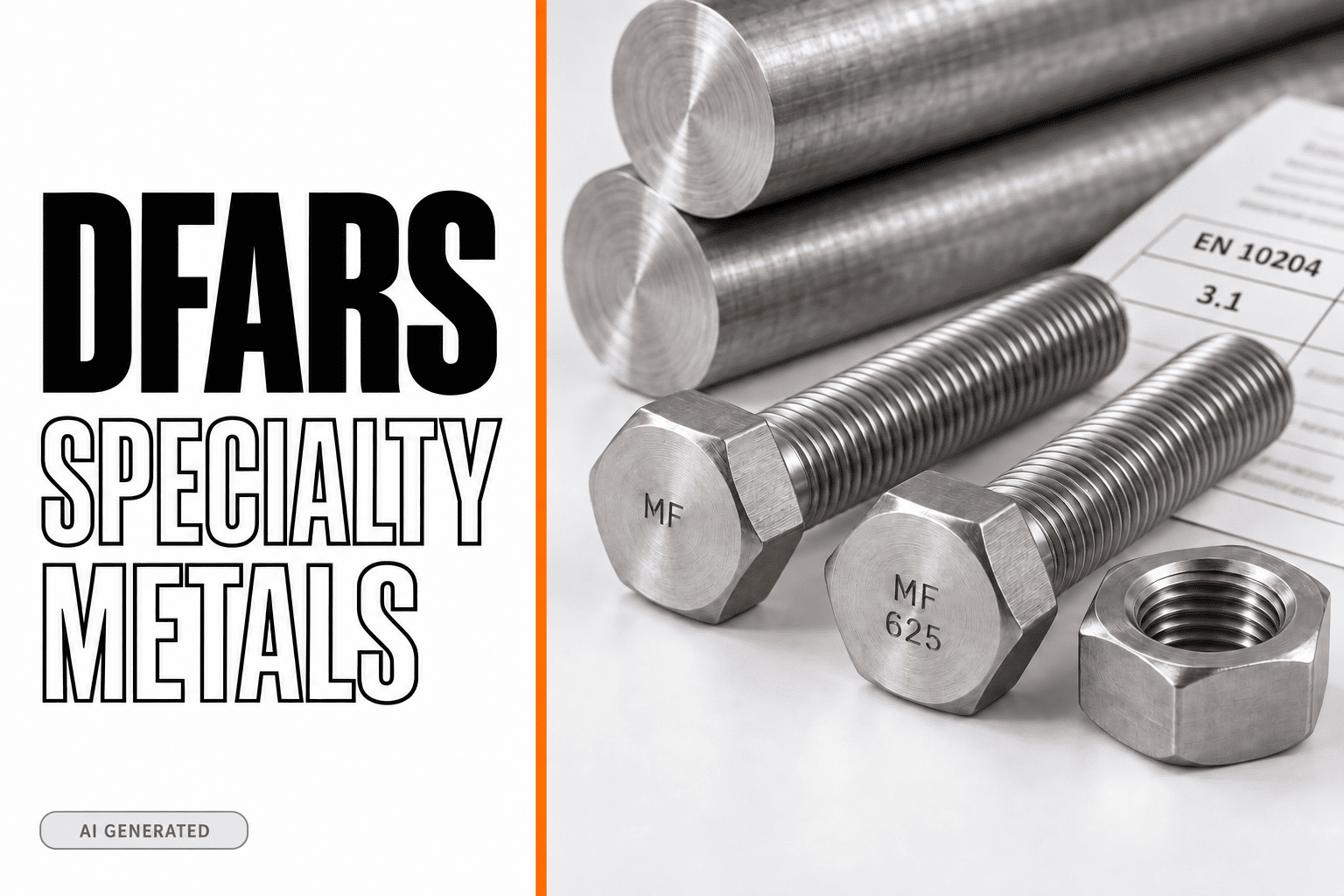
- Certificate 3.1 in accordance with EN 10204, with explicit indication of the country of origin of the melt. This is the key document: a certificate that lists only the chemical composition, without specifying the origin of the melt, proves nothing for DFARS purposes.
- A declaration of conformity that refers to the applicable clause and certifies the origin of the metal.
- Traceability from batch to part: the pour number listed on the production documents and linked to the shipped components.
- Upstream documentation chain, meaning the certificate from the steel mill—not just the one from the intermediate distributor.
The last point is the one that causes the most problems during an audit: if the bar has passed through two intermediaries and the original certificate from the steel mill cannot be retrieved, traceability is interrupted and compliance cannot be demonstrated.
In summary
The “specialty metals” clause is not a technical obstacle but a documentation-related one, and it applies to virtually everything produced by manufacturers of fasteners made of stainless steel, duplex steel, nickel alloys, and titanium: the 0.25% chromium threshold, by definition, includes all types of stainless steel.
The decisive factor is the country of smelting, not the country of processing; therefore, compliance is determined at the time of purchase of the ingot. And Italy, being among the qualified countries, starts from a favorable position: what’s needed is traceability, not an American supplier.
One final methodological note, which always applies to these projects: standard designations must be specified precisely, because not all material families are covered by the standards that are habitually cited—this is the case, for example, with the Alloy 800 family, which is not covered by ASTM A193.
This article is intended as a general guide and does not replace a review of the current text of the applicable clause or contractual advice. If you have a request for proposal with DFARS requirements and want to verify the feasibility of the material, our technical department can assist you in qualifying the supply: please contact us, specifying the applicable clause, the material, and the quantities.